
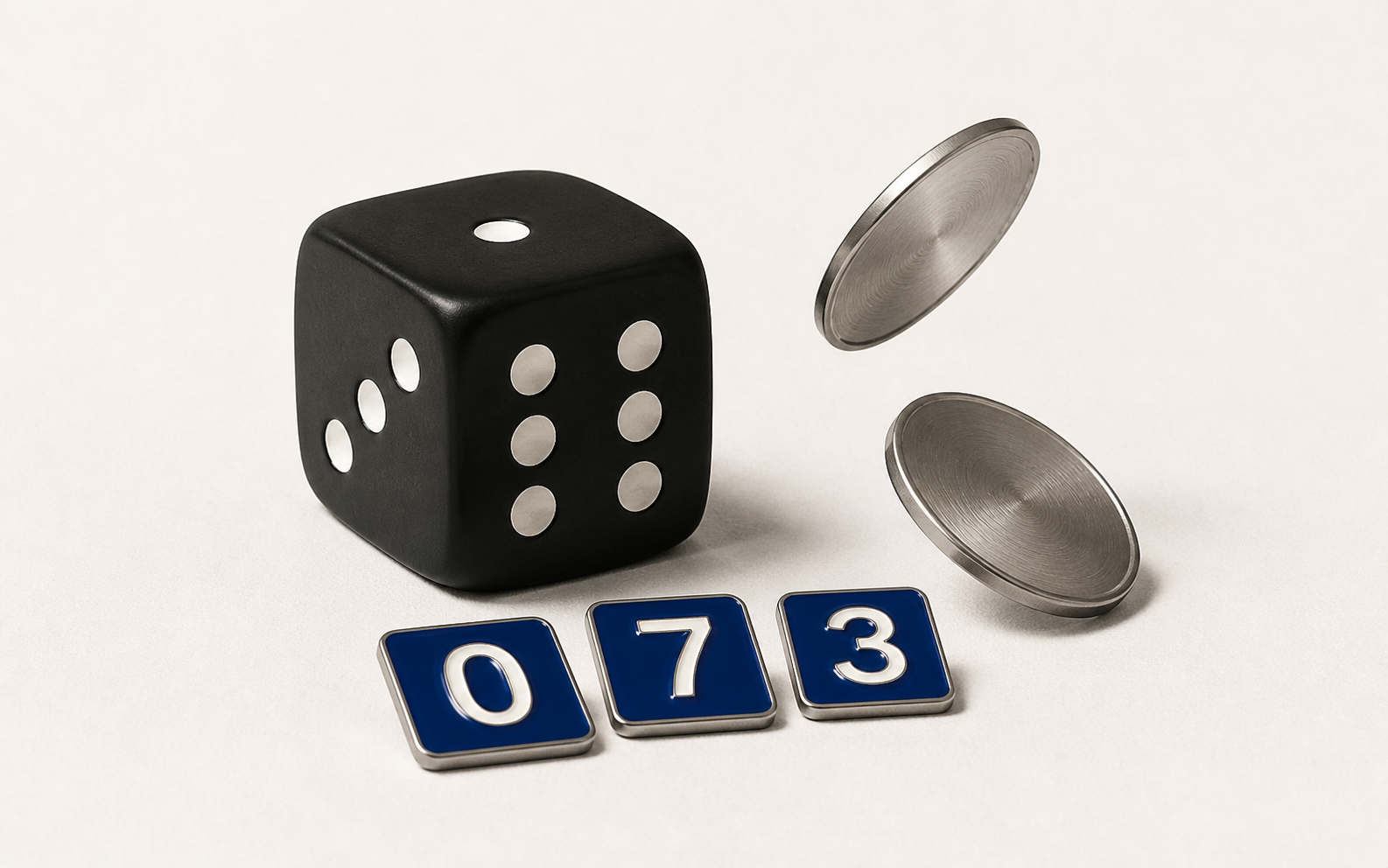
Most wallets create their recovery phrase from randomness generated inside the device. That is a sound, widely used default. Aperture also gives advanced users a radically tangible alternative: supply the wallet’s randomness yourself, one fair physical event at a time.
Roll a die. Flip a coin. Record a digit produced by a genuinely random physical process. Aperture converts those outcomes into one continuous bitstream and stops only when it has exactly 256 bits—the entropy required for a standard 24-word BIP-39 recovery phrase.
The point is not ceremony. It is direct control: every entropy bit begins with an event you performed and recorded.
Randomness you can hold in your hand
Physical entropy changes where wallet randomness comes from. Instead of asking the device to create the initial value, Aperture accepts outcomes from a source you can observe. The conversion happens locally, and the custom entropy contains only the values you enter. Aperture does not mix in device-generated randomness behind the scenes.
The interface keeps the process legible. It shows how many bits have been collected, preserves the recent input sequence, lets you undo the latest entry, and allows a complete reset. The final wallet action remains unavailable until the accumulator contains exactly 256 bits.
Three physical inputs. One continuous bitstream.
Dice rolls, coin flips, and random digits are not separate wallet modes. You can switch between them at any time. Every accepted result contributes to the same ordered stream, so the method can match the physical source in front of you.
Dice rolls
Use a fair six-sided die and enter every result in order. Faces 1 through 4 each map to two unbiased bits. Faces 5 and 6 each map to one bit. The variable contribution avoids forcing six equally likely outcomes into a four- or eight-value space, which would introduce bias.
Coin flips
A fair, independent coin flip is already binary: heads contributes one bit and tails contributes the other. Aperture records each side in sequence and updates the shared total immediately.
Random digits
Digits must come from a genuinely random physical process—not a birthday, a remembered number, or a pattern you invent. Digits 0 through 7 each contribute three bits; 8 and 9 each contribute one. As with dice, Aperture uses power-of-two groups so accepted outcomes do not favor one bit value over another.
What happens when the counter reaches 256
- Aperture packs the bits into 32 bytes. Inputs stay in their recorded order and are packed most-significant bit first.
- BIP-39 adds an 8-bit checksum. The checksum comes from the beginning of SHA-256 over the 32-byte entropy value.
- The resulting 264 bits become 24 words. They are split into 24 groups of 11 bits; each group selects one entry from the standard 2,048-word BIP-39 list.
- Wallet Core derives the wallet. The recovery phrase, plus an optional BIP-39 passphrase if you choose one, deterministically recreates the same accounts and addresses.
This is the standard relationship defined by the BIP-39 specification: 256 entropy bits, 8 checksum bits, and a 24-word mnemonic. Aperture uses Trust Wallet Core for standards-based wallet derivation.
Why this design matters
- Your source is explicit. The custom entropy is built from the physical outcomes you record, not from an opaque mixture of additional random values.
- Processing stays on-device. Aperture converts the sequence and creates the recovery phrase locally; the entropy sequence is not uploaded for processing.
- Different sources can be combined. Switching input types never starts over. All accepted results join the same ordered 256-bit value.
- The process is inspectable. Progress, recent inputs, undo, and reset controls make the state visible before a wallet can be created.
Physical entropy is an alternative source of wallet randomness. It is not an extra password, and it is not automatically safer than the standard creation flow. Its security depends entirely on the fairness, independence, privacy, and accuracy of your physical process.
Use physical entropy safely
If you cannot guarantee a fair source, private surroundings, and exact recording, use Aperture’s standard wallet creation instead.
- Use a fair coin or die, and make each event independent of the last.
- Keep the complete process away from cameras, screen recording, and other people.
- Record every result exactly once and in the order it occurred. One missing, duplicated, or reordered entry creates a different wallet.
- Never invent “random-looking” digits. Human choices and familiar patterns are predictable.
- Back up the completed recovery phrase offline, verify it before funding the wallet, and securely destroy intermediate notes you no longer need.
How to build yours
- Open wallet setup in Aperture and choose Build Your Entropy.
- Select Dice Rolls, Coin Flips, or Random Digits.
- Perform each physical event and record the result immediately. Switch methods whenever you need to—the progress continues.
- Review the visible history as the counter approaches 256 bits. Use Undo if the latest entry is wrong; reset if the sequence cannot be trusted.
- When all 256 bits are collected, create the wallet and make a durable offline backup of the resulting 24-word recovery phrase.
Aperture’s physical-entropy flow makes an invisible cryptographic starting point visible, deliberate, and yours. The final result remains a familiar, interoperable BIP-39 wallet—but the first moment of randomness can begin in your own hands.